
How a Consistent Sleep Schedule Helps You Feel More Human?
The Case for Waking Up at the Same Time Every Day—Even on Weekends
Ever feel like you're doing everything right for your sleep, but still waking up foggy, dragging through the day, or lying wide-eyed at night? You’re not alone — and you’re not broken.
Sleep is a lot like falling in love. You can’t force it — in fact, the more you chase it, the more it tends to slip away. But when you create the right conditions — calm, consistency, and good timing — it often arrives naturally.
Here’s the part many people miss: when you go to bed and wake up is just as important as how you sleep. It’s not only about getting enough hours — it’s about giving your body the rhythm and routine it needs to do what it’s designed to do: rest, restore, and reset.
🧠 Meet Your Circadian Rhythm
Your body runs on a built-in clock called the circadian rhythm — a 24-hour cycle that influences everything from your energy and mood to digestion, hormones, and, of course, sleep. This rhythm is shaped by cues like light, movement, temperature, and your daily habits. One of the strongest ways to support it? Waking up at the same time every day.
When your schedule swings — like sleeping in on weekends or taking long naps — it can throw that rhythm off. This makes it harder to fall asleep at night and harder to feel truly rested in the morning. That groggy, jet-lagged feeling after a Sunday sleep-in? That’s not extra rest — it’s your circadian rhythm falling out of sync.
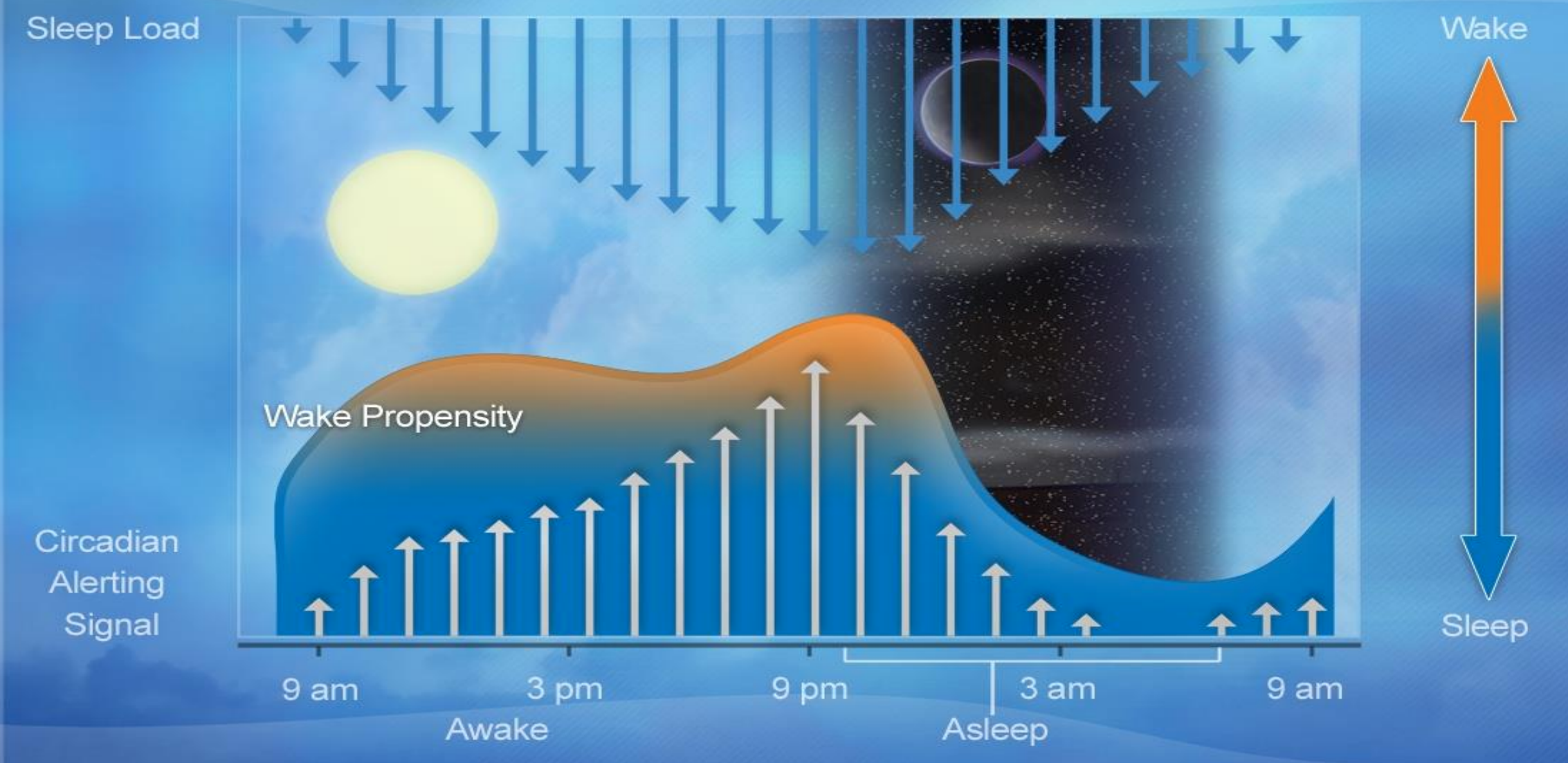
Figure adapted from Kilduff et al. 1999: How your body knows when to sleep and wake up
This image shows how two things work together to help you sleep well:
The sleep load (top arrows) builds the longer you're awake — like pressure building up in a balloon.
The circadian rhythm (bottom arrows) is your body’s internal clock that keeps you alert during the day and winds you down at night.
When these two systems are in sync — especially with a regular wake-up time — falling asleep and waking up feels easier and more natural.
Why Irregular Sleep Throws You Off
Even a small shift in your sleep timing can lead to:
Difficulty falling asleep or waking up
Reduced alertness and mood
Poorer recovery from stress
Long-term health effects like metabolic issues and low immune resilience
In fact, one large-scale study found that just a one-hour shift in weekend sleep timing was associated with poorer mood, increased sleepiness, and reduced cognitive performance during the week (Wittmann et al., 2006).
Another study showed that irregular sleep-wake patterns were linked to worse academic performance and delayed sleep phase in college students (Phillips et al., 2017).
In other words: staying up late and sleeping in can feel good in the moment—but your brain and body may pay for it later.
1. Wake Up at the Same Time Every Day.
This is your anchor — your rhythm’s reset button. Even if you had a rough night, resist the urge to sleep in. And yes, that includes weekends.
Avoid:
Snoozing (fragmented sleep = groggier brain)
Napping (can sabotage your drive to sleep that night)
Instead, build a sleep routine that prioritizes consistency first.
2. Set a Regular Lights-Out Time — But Only Lie Down When Sleepy
This part is more nuanced. You’ve probably heard, “Go to bed and wake up at the same time every day.” But what if your chosen bedtime arrives and… you’re just not sleepy?
Here’s the thing: lying in bed wide awake can actually make things worse. It teaches your brain that the bed is a place for tossing, turning, or worrying — not sleeping.
So, try this balanced approach:
Pick a target bedtime that allows for 7–9 hours of sleep opportunity (everyone’s sweet spot varies).
Start winding down about 60 minutes beforehand — lower the lights, avoid stimulating screens, and follow a calming bedtime routine (like hygiene, reading, or stretching).
At your target time, ask yourself: Am I sleepy?
If yes → Lie down and turn off the lights.
If no → Stay out of bed and do something quiet, dark, and relaxing until sleepiness arises.
🧘♀️ Sleepy ≠ just tired or stressed. Sleepy = eyelids heavy, body slowing, head nodding.
There’s even an exception here:
Some people don’t feel sleepy until they lie down in a dark room. If that’s you, it’s okay to go to bed at your chosen time — just commit to getting up again if you’re not asleep within about 20 minutes.
3. If You Wake Up in the Night… Get Up
If you’re awake in bed for more than ~20 minutes, it’s time to hit reset — gently.
Why? Because again, we want your brain to associate the bed with sleep, not wakefulness.
Tips:
Don’t clock-watch — just go by your sense of time.
Get out of bed and move to a dim, quiet space.
Do something calming and non-stimulating (read a boring book, listen to soft music, meditate).
Avoid phones, bright screens, or anything that makes you feel productive or engaged.
Keep it short and flexible — return to bed when you feel sleepy again.
🧣 Pro tip: Plan ahead. Set up a robe, slippers, a cozy blanket, and a low-light activity ahead of time so it’s easier to follow through.
⚠️ Important: This is best for people experiencing repeated nighttime awakenings and should not be used if you’re a fall risk, have mobility issues, or have taken sleep medication. In those cases, try a calming activity in bed instead—like deep breathing or a body scan.
🍰 And remember: as Dr. Colleen Carney says, you can be a little looser with the “rules” if your sleep isn’t causing daytime problems. No need to be perfect—just consistent enough to help your system reset.
4. Sleep Only in Bed (and Return to Bed When Sleepy)
Even if you're tempted to doze off on the couch or in a chair — avoid it. Keeping sleep only associated with your bed helps reinforce the brain’s connection: bed = sleep, not TV, not worrying, not scrolling.
You might get sleepy again in 5 minutes, or 2 hours, or not at all — and that’s okay. The long game is training your system, not getting one perfect night.
📝 Want to Track Progress?
We’ve created a simple Sleep Tracker in this book to help you keep tabs on your habits.
💬 Final Thoughts
Sleep isn’t a switch. It’s a rhythm. Consistency—especially with your wake-up time—is what allows that rhythm to stabilize.
But going to bed? That’s about tuning in to your body. Give yourself a regular window to be ready for sleep, and the flexibility to listen to your cues.
That’s how you build a sleep routine that works —not just in theory, but in real life.

Dr. Jo Epping-Jordan, Registered Psychologist
RELATED POSTS